
Air conditioning
Car AC Leaks: Why an Annual Regas Is Not Normal
Air conditioning does not use refrigerant up. It is a sealed system, and the amount in it when it left the factory should still be in it. If your car needs gas every summer, you do not have a system that needs topping up, you have a leak nobody has found.
What this guide covers
Why This Matters More Than It Sounds
The refrigerant carries the compressor oil around the system. That is the detail almost nobody knows and it changes everything about how urgent a leak is.
A system low on refrigerant is also low on oil circulation, so the compressor runs increasingly dry.
That is why an air conditioning system that has been repeatedly topped up rather than repaired eventually fails at the compressor, which is the most expensive component in it.
And when a compressor fails internally it sends debris through the system, so the drier and expansion valve become part of the repair too.
A workshop that regasses without finding the leak is selling you the same job next year, and the year after that the compressor. Ask what leak detection was done before any gas goes in.
Where the Leaks Actually Are
The condenser
The most common source. It sits at the front of the car, low down, ahead of the radiator, exactly where stones and road debris hit it.
In this region the sand blasting past it over years does slow damage as well, and its fins corrode.
O-rings and hose connections
Every joint in the system is sealed by a rubber O-ring, and heat hardens them until they no longer seal.
These are inexpensive parts and a common cause of a slow leak, which is one reason a proper diagnosis often costs less than owners expect.
The compressor shaft seal
The compressor has a rotating shaft and a seal around it. Seals dry out, particularly on a car whose air conditioning is used rarely.
The evaporator
Inside the dashboard, so a leak here appears as nothing outside the car and gradually reducing cooling.
Access is labour-heavy, which is why it is pressure tested rather than assumed.
The service ports
The valves used to connect gauges can leak slowly through their cores, and their caps are part of the seal rather than decoration.
How a Leak Is Actually Found
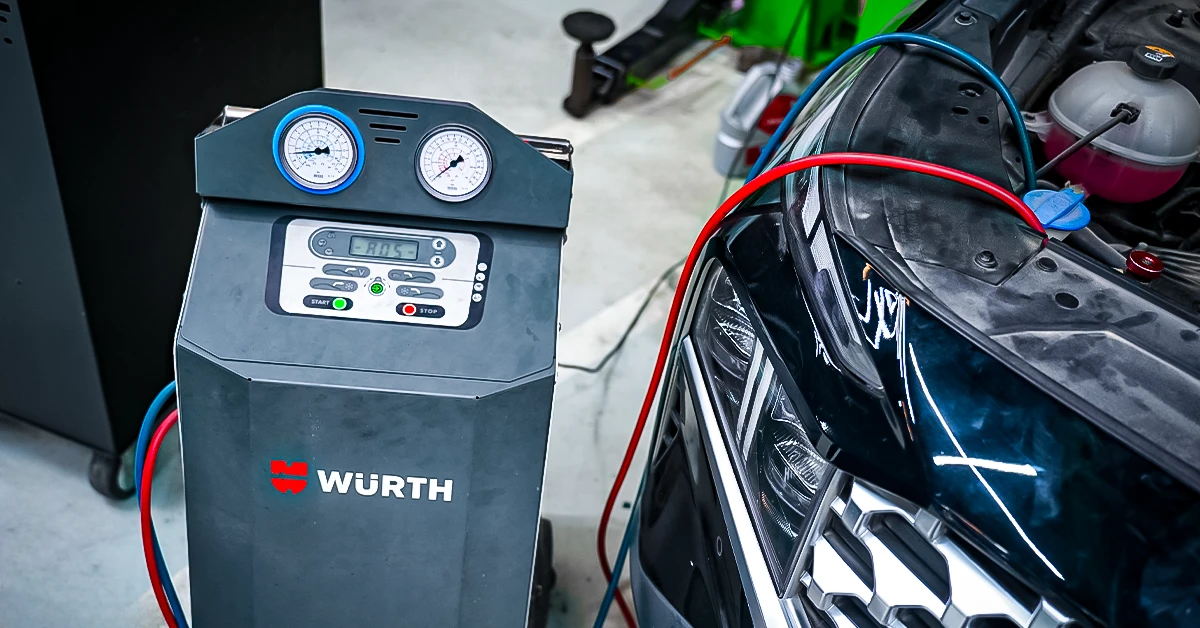
- Measure what is in the system by recovering and weighing the refrigerant. That alone tells you how much has been lost.
- Pressure test with nitrogen, which is inert and holds pressure so a leak can be heard or found with solution.
- Add UV dye where the leak is slow, then run the system and inspect under UV light.
- Use an electronic leak detector around joints and components.
- Recharge by weight, not by pressure, to the manufacturer figure.
That last point matters. A system is charged by weight to a specific figure, and guessing by gauge pressure produces an over or undercharge that both reduce cooling.
Why Top-Up Cans Backfire
The cans sold with a gauge and a trigger are tempting and they cause several problems.
- They cannot measure a charge. A system is filled by weight, and a gauge on the low side tells you almost nothing on its own.
- Overcharging reduces cooling and raises pressures, which stresses the compressor.
- Many contain sealant. That circulates and can block the expansion valve, the narrowest passage in the system.
- Sealant contaminates recovery equipment, which is why some workshops will decline to work on a system that has had it.
- They do nothing about the leak, so the gas escapes again.
The sealant point is worth taking seriously: it can make a straightforward repair considerably more expensive and awkward.
When It Is Not a Leak at All
A good share of weak cooling complaints have nothing to do with refrigerant, and it is worth ruling these out before anything is added.
- The cooling fan. Cold while moving and warm at a standstill is almost always airflow across the condenser rather than charge.
- A blocked condenser. Sand packed into the fins stops it shedding heat while it looks clean from the front.
- The cabin filter. Cheap, frequently neglected, and often the whole of a weak airflow complaint.
- A flap actuator. Ticking behind the dashboard and one zone at the wrong temperature is electrical, not refrigerant.
- A blocked condensate drain. Water on the carpet instead of the road.
See car AC repair.
Cars That Are Rarely Driven
A system that never runs dries its seals out, because the compressor seals depend on refrigerant oil circulating.
This is why a car stored for a season frequently loses its charge, and it is entirely preventable.
Running the air conditioning for a few minutes every couple of weeks keeps the seals wetted. It costs nothing and it prevents a common repair.
Frequently Asked Questions
Why does my car AC need regassing every year?
Because it has a leak. An air conditioning system is sealed and does not consume refrigerant, so the charge it left the factory with should still be there. An annual regas is not maintenance, it is a leak that nobody has looked for, and each year the compressor runs a little drier.
Is it bad to run an AC system low on refrigerant?
Yes, and worse than most owners realise. The refrigerant carries the compressor oil around the system, so a low charge means poor oil circulation and a compressor running increasingly dry. That is how repeated topping up ends in a compressor failure, which then contaminates the system with debris.
Are DIY AC top-up cans a good idea?
They cause more problems than they solve. A system is charged by weight to a specific figure and a can with a gauge cannot measure that, so overcharging is common and reduces cooling. Many also contain sealant, which can block the expansion valve and contaminates recovery equipment, and none of them address the leak.
Where do car air conditioning leaks usually come from?
The condenser most often, because it sits low at the front where stones and road debris hit it and where sand corrodes the fins over years. Hardened O-rings at hose connections are the next most common and are inexpensive parts. The compressor shaft seal and the evaporator inside the dashboard account for most of the rest.
My AC is cold when moving but warm in traffic. Is that a leak?
Usually not. That pattern points at airflow across the condenser rather than refrigerant charge: either a failed cooling fan or a condenser packed with sand and dust. Both are inexpensive to put right, and adding gas to a system that is not short of it achieves nothing.

