Servicing
Six Failure Chains That Start With a Skipped Service
Cars do not fail randomly. They fail along predictable chains, where a cheap item that was skipped leads to a specific expensive one. Each chain has a point where it stops costing almost nothing and starts costing a great deal.
What this guide covers
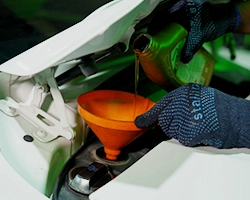
1. Oil Interval to Turbocharger
Almost every modern engine here is turbocharged, and the turbo is cooled and lubricated by engine oil while spinning extremely fast and running very hot.
- Oil interval stretched to save one service.
- Oil oxidises and thickens, and its ability to carry heat drops.
- The turbocharger bearing runs hotter than designed.
- Bearing wear, then shaft play, then the turbo.
Where it stops: at the first step, for the price of an oil service with the correct specification. See why the specification matters.
2. Coolant Top-Up to Head Gasket
A cooling system is sealed and does not consume coolant. A falling level always means a leak.
- A small leak appears and is topped up rather than traced.
- The leak worsens, as heat-aged plastic and rubber always do.
- One hot day in traffic, the level is low enough that temperature rises.
- The aluminium cylinder head distorts and the gasket seal fails.
Where it stops: at a hose or a plastic housing, both inexpensive. See where coolant leaks come from.
3. Shudder to Gearbox
Torque converter shudder is a fine shimmer at light throttle, often described as driving over a rumble strip.
- Lock-up clutch material begins to break down and shudder appears.
- The debris contaminates the transmission fluid.
- Contaminated fluid degrades faster and lubricates less.
- Clutch packs and the valve body wear, and the shudder becomes slipping.
Where it stops: at a fluid and filter service, early. After the fluid is contaminated it is a mechanical repair. See what each gearbox symptom means.
4. Brake Pads to Calipers
The clearest chain of all, and the easiest to see coming because it is measured at every service.
- Pads wear past the indicator and the squeal is ignored.
- Friction material runs out and metal contacts the disc.
- Discs are grooved and must be replaced with the pads.
- Overheating from metal-on-metal damages the caliper seals and piston.
Where it stops: at a set of pads. See squeal versus grinding.
5. Warning Light to Catalytic Converter
A flashing engine warning light during a misfire is the most expensive light on the dashboard to ignore.
- A coil or plug fails and a cylinder misfires.
- Unburnt fuel passes into the exhaust.
- The catalytic converter overheats trying to process it.
- The converter fails, at many times the cost of the coil.
Where it stops: at an ignition coil, which is among the cheapest parts on the engine. See engine misfires.
6. Suspension to Tyres and Beyond
The slowest chain, and the one owners adapt to without noticing.
- A damper fades and stops controlling the spring properly.
- The wheel begins to bounce rather than follow the road.
- Tyres cup and wear unevenly, and braking distances lengthen.
- Bushes, mounts and wheel bearings absorb loads the damper should have.
Where it stops: at a pair of dampers, before a set of tyres and several other components. See why worn suspension is a braking problem.
What They Have in Common
Every chain above shares the same three features, and recognising them is the useful part.
- The first step is cheap. Oil, a hose, a fluid service, a set of pads, a coil, a pair of dampers.
- There is a warning. A level dropping, a shudder, a squeal, a light, a change in ride.
- The consequence is disproportionate. Not twice the cost, frequently ten times or more.
That second point is the reason a service is worth what it costs. An hour on a ramp is when a chain gets caught at step one rather than step four.
This is also why measurements matter more than a verdict. A brake reading, an oil condition note or a damper check tells you where you are in a chain, which is information you can act on before it becomes urgent.
The Honest Version
Servicing does not prevent everything. Components fail on well-maintained cars, and some repairs are simply the cost of running a vehicle.
What servicing does is stop the avoidable ones, and the avoidable ones are the expensive ones.
Exotic Auto Services in Musaffah shares the measurements at every service, so you can see which chains are running and where you are on them.
Frequently Asked Questions
Does regular servicing actually save money?
It stops the avoidable failures, and those are the expensive ones. Cars fail along predictable chains where a cheap skipped item leads to a specific costly component: a stretched oil interval to a turbocharger, a topped-up coolant leak to a head gasket, an ignored shudder to a gearbox. Each has a point where it stops costing almost nothing.
What is the most expensive maintenance mistake?
Stretching the oil interval on a turbocharged engine, because the oil is what cools the turbocharger as well as lubricating the engine. The saving is one service and the consequence is the most expensive component on the engine, which makes it the poorest trade available.
Why is topping up coolant a problem?
Because a cooling system is sealed and does not consume coolant, so a falling level always means a leak that is getting worse. Topping up manages the symptom while the leak grows, and eventually the level is low enough on a hot day that the cylinder head distorts. The hose was the cheap part.
How much damage does ignoring a flashing engine light cause?
A flashing light during a misfire means unburnt fuel is passing into the exhaust and overheating the catalytic converter. The original fault is usually an ignition coil, among the cheapest parts on the engine, and the converter costs many times that. It is the most expensive light on the dashboard to ignore.
Does servicing prevent all repairs?
No, and it would be dishonest to claim otherwise. Components fail on well-maintained cars and some repairs are simply part of running a vehicle. What servicing does is catch the chains early, and the chains are where the disproportionate costs come from.