Suspension
Control Arm Replacement: What the Job Involves
A control arm is the link between the wheel and the car, and it wears at its two rubber and metal joints rather than in the arm itself. Whether you need an arm or just a bush is the question that decides the bill.
What this guide covers
What a Control Arm Does
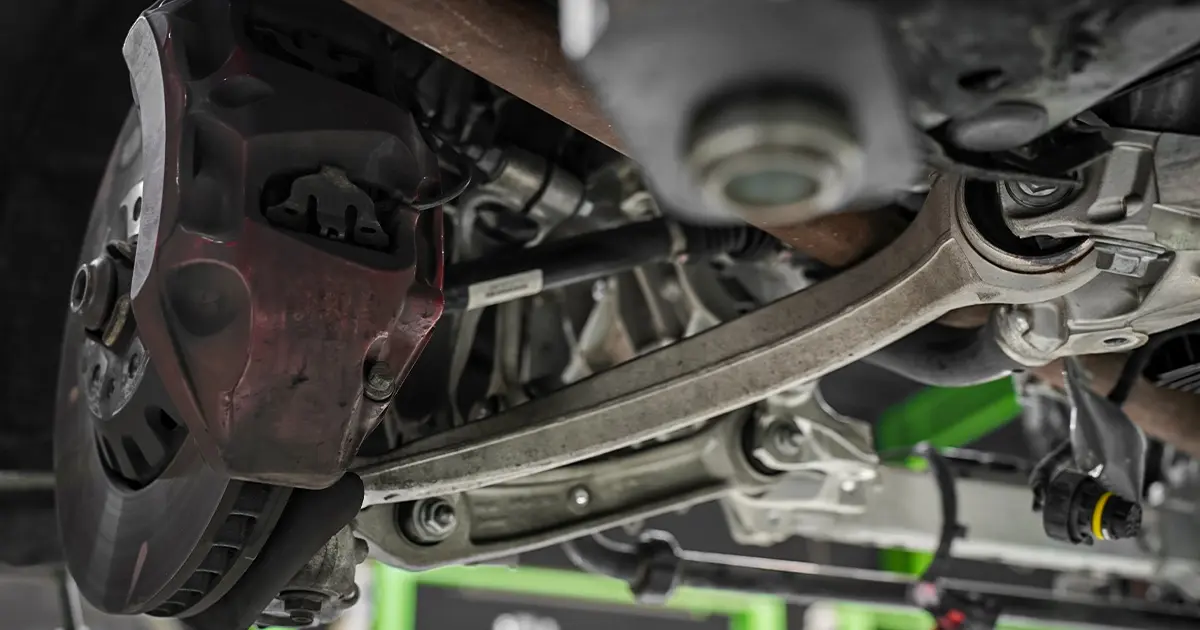
It locates the wheel relative to the car, holding it in the correct position while allowing it to move up and down.
It attaches to the body or subframe through rubber bushes at one end, and to the wheel hub through a ball joint at the other.
The arm itself is a substantial piece of metal and almost never the thing that fails. The joints at each end are what wear.
Why the Joints Wear Here
Bushes
A bush is rubber bonded between two metal sleeves. It allows a small controlled movement and absorbs vibration.
Heat cycling hardens that rubber until it cracks and separates from the sleeve. Once it does, the arm moves further than it should.
That is a time and temperature failure rather than a mileage one, which is why a low-mileage car in Abu Dhabi can need bushes.
Ball joints
A ball joint is a metal ball in a socket, packed with grease and sealed by a rubber boot.
When the boot splits, grease escapes and dust gets in. In this region that ruins a joint quickly.
A split boot found early is a strong argument for acting before the joint is damaged, because the boot is cheap and the joint is not.
Symptoms
- A knock or clunk over bumps, duller than the sharper rattle of an anti-roll bar link.
- Vague steering or a car that wanders and needs constant correction.
- Uneven tyre wear, usually on the inside edge.
- A creak at low speed over uneven ground.
- An alignment that will not hold, which is a strong indicator of play.
See what each suspension symptom points at for how to tell these apart from other components.
Bush or Complete Arm?
This is where quotes vary most, and it is worth understanding rather than assuming you are being upsold.
On some cars the bush can be pressed out and a new one pressed in, using a hydraulic press and the correct tooling. That is cheaper in parts and higher in labour.
On many modern cars the manufacturer supplies the arm complete with bushes and ball joint, and separate bushes are simply not available.
On cars where the ball joint is integral to the arm, a worn joint means a new arm regardless of the condition of the bushes.
If you are quoted for a complete arm, it is reasonable to ask whether the bush is available separately. On plenty of cars it genuinely is not, and a workshop that can explain which applies to yours is worth using.
Why This Is Not a Driveway Job
The old version of this page was a step-by-step guide. There are good reasons not to publish one.
- Spring energy. On many designs the arm is under spring load, and releasing it without controlling the spring is genuinely dangerous.
- Torque-to-yield fasteners. Many suspension bolts are single-use and stretch by design. Reusing them is not safe.
- Loaded torquing. Bush bolts must generally be tightened with the suspension at normal ride height, not hanging. Get that wrong and the new bush is pre-twisted and fails early.
- Press work. Pressing bushes needs a proper press and the right adapters.
- Alignment. The car is not safe to drive properly until it is realigned.
That third point is the one most commonly missed even in workshops, and it is why some replacement bushes fail within a year.
The Alignment Is Part of the Job
Replacing a control arm changes the geometry, always.
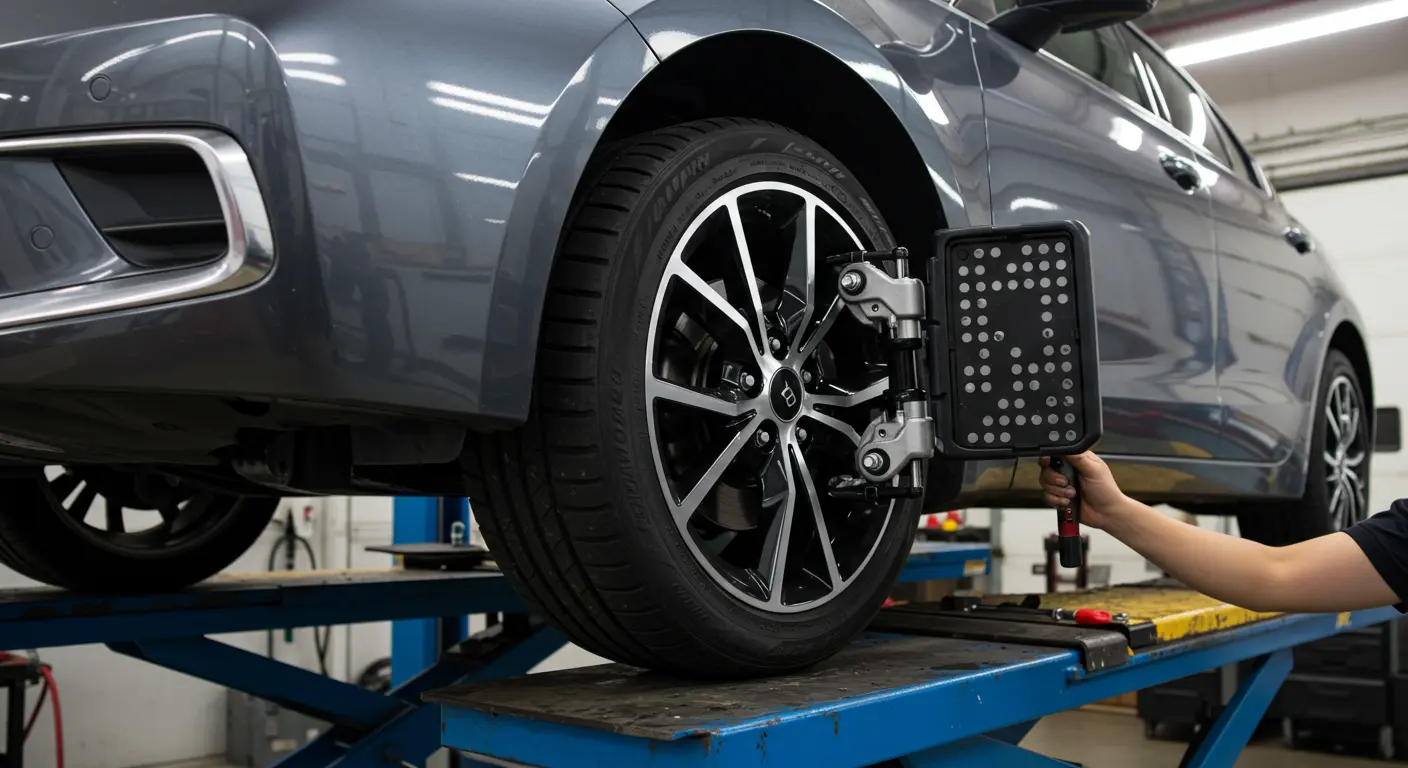
A four-wheel alignment afterwards is not an upsell, it is the completion of the work. Without it the car will pull, wander or eat the new tyres.
If a quote for control arm work does not include alignment, that is worth asking about before the work starts rather than after.
See six signs your wheels need alignment.
Replacing in Pairs
Where budget allows, both sides is usually the better decision.
The other arm is the same age and has seen the same heat, so replacing one often means returning within a year for the other.
It also shares the labour and the alignment, so doing both is considerably less than two separate visits.
Exotic Auto Services will tell you honestly whether the other side genuinely needs it or has life left, with the measurements to back it.
Frequently Asked Questions
What are the symptoms of a worn control arm?
A dull knock over bumps, vague steering or a car that wanders, uneven tyre wear usually on the inside edge, and a creak at low speed over uneven ground. An alignment that will not hold is also a strong indicator, because play in the arm lets the geometry move once the car is back on the road.
Can just the bush be replaced instead of the whole arm?
Sometimes. On some cars the bush presses out and a new one presses in, which is cheaper in parts and higher in labour. On many modern cars the manufacturer only supplies the arm complete, and where the ball joint is integral a worn joint means a new arm regardless. It is reasonable to ask which applies to your car.
Do I need an alignment after replacing a control arm?
Yes, always. Replacing an arm changes the geometry, so a four-wheel alignment is the completion of the job rather than an extra. Without it the car will pull or wander and will wear the tyres unevenly, which costs more than the alignment would have.
Should control arms be replaced in pairs?
Usually, where budget allows. The other side is the same age and has seen the same heat, so replacing one often means returning within a year for the other. Doing both together shares the labour and the alignment, which makes it considerably cheaper than two separate visits.
Why do control arm bushes fail in the UAE?
Heat. A bush is rubber bonded between metal sleeves, and heat cycling hardens that rubber until it cracks and separates. It is a time and temperature failure rather than a mileage one, which is why a car with modest kilometres here can need bushes while a higher-mileage car elsewhere does not.