Engine
Timing Belt Replacement in the UAE: When, Signs and Cost
Quick Summary
Replace a timing belt at the interval in your service schedule, by distance or age, whichever comes first. Use the shorter hot-weather interval where your manufacturer lists one. Warning signs include ticking or slapping noises, oil near the belt cover, misfires and a no-start. The cost depends on engine layout, the parts replaced with the belt and their quality.
The timing belt keeps an engine's valves and pistons moving in perfect time, and it usually gives little warning before it fails. On many engines, a broken belt causes serious internal damage, so knowing when to replace it matters.
In the UAE, a timing belt should be replaced at the interval in your service schedule, typically between about 100,000 and 160,000 km or a set number of years, and sooner where the manufacturer lists a shorter interval for very hot conditions.
What this guide covers
What a Timing Belt Does
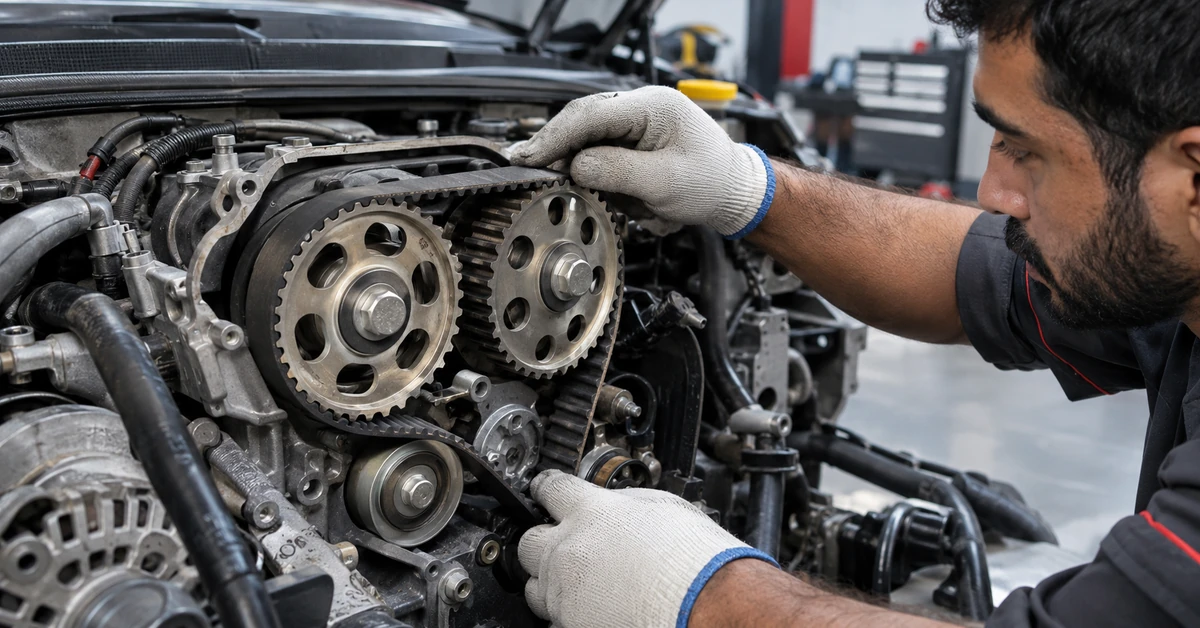
The timing belt links the crankshaft to the camshafts, keeping the valves opening and closing in perfect time with the pistons. It is a toothed rubber belt reinforced with strong fibres, running behind a cover at the front or side of the engine.
In an interference engine, the valves and pistons share the same space at different moments. If the belt breaks, the valves stop moving while the pistons keep going, and they collide. That is why a broken belt can be so expensive.
Timing Belt vs Timing Chain
Not every car has a belt. Many engines use a metal timing chain instead, which usually lasts much longer and has no fixed replacement interval.
| Feature | Timing belt | Timing chain |
|---|---|---|
| Material | Reinforced rubber with teeth | Metal links |
| Location | Dry behind a cover, or inside the engine on some newer "wet belt" designs | Inside the engine, lubricated by oil |
| Replacement | At a set interval in km or years | Usually only when worn or noisy |
| Failure warning | Often little or none | Rattling, timing fault codes |
| Typical noise | Quiet | Slightly louder |
Examples of engines that use belts include many Honda V6 models, several Volkswagen and Audi petrol and diesel engines, some Mitsubishi V6 engines and a number of small turbocharged engines with wet belts. Many Toyota, Nissan, BMW and Mercedes engines use chains. Your owner's manual or a workshop can confirm which your car has.
When to Replace a Timing Belt in UAE Conditions
Manufacturers set intervals by distance and age. Rubber ages even when the car is not driven, so a low-mileage car can still need a new belt on time.
Heat matters too. Honda's owner's manual guidance tells drivers to replace the timing belt at 100,000 km if they regularly drive in very high temperatures, over 43°C, much earlier than the normal schedule. Many UAE drivers meet that condition for months every year.
| Situation | Suggested approach |
|---|---|
| Normal schedule reached | Replace at the km or years stated, whichever comes first |
| Car driven mostly in UAE summer heat | Check whether your manufacturer has a severe-use interval and follow it |
| Unknown service history on a used car | Replace the belt soon after purchase unless there is proof it was done |
| Oil or coolant leaking onto the belt | Fix the leak and replace the belt, as fluids weaken rubber |
| Water pump driven by the belt is leaking | Replace pump and belt together |
If you are buying a used car with a belt-driven engine, ask for proof of the last replacement. A pre-purchase inspection can help check service records and the belt's visible condition.
Warning Signs of a Worn Timing Belt
Timing belts often fail without warning, which is why replacing on schedule matters. Some signs can still appear before failure.
Ticking or Slapping Noises
A worn tensioner or a belt that has stretched may cause ticking or slapping sounds from the front of the engine. A whining noise can point to a failing idler pulley or tensioner bearing.
Oil Leaks Near the Belt Cover
Oil from a leaking camshaft or crankshaft seal can soak the belt and weaken the rubber. Any oil leaks seeping from behind the timing cover should be checked quickly, before the belt starts to break down.
Misfires, Rough Running and Warning Lights
If the belt has jumped a tooth, valve timing will be off. The engine may misfire, run roughly, lose power or show a check engine light with timing-related codes.
Visible Cracks or Missing Teeth
Where the belt can be inspected, cracks across the back, glazing, fraying edges or missing teeth mean replacement is overdue.
Engine Won't Start
If the engine cranks but will not start, and the starter sounds unusually free, the belt may already have broken. Do not keep cranking, as this can cause more damage.
What Is Usually Replaced With the Timing Belt
Labour is the biggest part of a timing belt job because the engine front must be partly dismantled. Replacing related parts at the same time avoids paying that labour twice.
| Part | Why replace it with the belt |
|---|---|
| Tensioner | Keeps the belt at the right tension, and wears at a similar rate |
| Idler pulleys | Bearings can fail and destroy a new belt |
| Water pump | Often driven by the belt, and a leak would ruin the new belt |
| Camshaft and crankshaft seals | Leaks onto a new belt shorten its life |
| Drive belts | Usually removed anyway, so cheap to renew |
| Coolant | Needed if the water pump is changed |
What Decides Timing Belt Replacement Cost
The price varies more between engines than most owners expect. Several factors decide the bill.
Engine Layout
A transverse four-cylinder engine with good access may need a few hours of labour. A V6 mounted sideways in a tight engine bay can take most of a working day. Some wet belt designs run inside the engine and need more dismantling.
Parts Included
A belt-only job is cheapest but risky. A full kit with tensioner, idlers and water pump costs more in parts but protects the engine and avoids a second labour charge.
Parts Quality
Genuine and OEM-equivalent kits are designed to last the full interval. Very cheap belts or tensioners can fail early, with expensive results.
What It Costs If the Belt Breaks
On interference engines, a broken belt can mean bent valves, damaged pistons and cylinder head work. That kind of engine repair typically costs many times more than a planned timing belt replacement, which is why replacing it on time is one of the best value jobs on any belt-driven car.
How Exotic Auto Services Handles Timing Belt Replacement
Exotic Auto Services checks your engine's manufacturer interval and service history first, then inspects the belt, tensioner, pulleys and water pump. You receive an itemised quotation showing each part and the labour time before any work begins.
The workshop fits OEM-equivalent timing kits as standard, with genuine parts on request, and sets timing using the correct tools for your engine. Belt replacement can be added to a major service, and free pick-up and drop-off is available with a service contract.
Frequently Asked Questions
How often should a timing belt be changed in the UAE?
Follow your manufacturer's interval in km or years, whichever comes first. If your manufacturer lists a shorter interval for very hot conditions, use that one. Many belts fall in the range of about 100,000 to 160,000 km, but it varies by engine.
What happens if a timing belt breaks while driving?
The engine stops immediately and will not restart. On interference engines, the valves and pistons can collide, causing serious internal damage. The car will need recovery, and repair costs are often far higher than a planned replacement.
Does my car have a timing belt or chain?
Check the owner's manual or service schedule, which lists a timing belt replacement if your car has one. A workshop can also confirm it from the engine code. Many modern engines use chains, but plenty of popular models still use belts.
Should the water pump be replaced with the timing belt?
If the water pump is driven by the timing belt, it is usually best to replace it at the same time. Most of the labour is already done, and a pump that leaks later can damage the new belt and require the whole job to be repeated.
How long does timing belt replacement take?
It depends on the engine. Simple four-cylinder engines may take a few hours, while V6 engines and wet belt designs can take most of a day. Your quotation should show the labour time so you know what to expect.
Conclusion
A timing belt is a small part with a huge job, and when it fails, the damage can be severe. In the UAE, heat adds to the wear, so following your manufacturer's interval, or its severe-use interval where one exists, is the safest approach.
Replacing the tensioner, pulleys and water pump at the same time protects the engine and your budget. Book a planned replacement as part of a major service with Exotic Auto Services in Musaffah.