Engine
Common Engine Problems in European Cars, and Why They Happen Here
European engines are not less reliable than others. They are engineered to a different set of priorities, and those priorities produce a predictable handful of faults, all of which get worse in Abu Dhabi heat.
What this guide covers
The Design Decisions Behind the Faults
European manufacturers faced tight emissions and economy targets, and answered with smaller, harder-working engines.
A 2.0 turbo producing what a 3.0 used to is more efficient and under considerably more thermal and mechanical stress.
Nearly every common fault below follows from that one decision, plus the climate it now operates in.
1. Turbocharger Failure Traced to Oil
The turbocharger spins at enormous speed and runs extremely hot, and it is cooled and lubricated by engine oil.
Oil that has degraded, or an interval that was stretched, damages the turbo before it damages anything else.
This is the most expensive consequence of a cheap oil change, and it is entirely preventable.
On a turbocharged European engine, the oil specification is not a viscosity preference. The manufacturer approval exists because the oil is doing a cooling job as well as a lubricating one, and an approximate match is not the same product.
2. Carbon on Direct Injection Intake Valves
On a port injection engine, fuel sprays past the intake valves and washes them continuously.
Direct injection sprays fuel into the cylinder instead, so nothing cleans the valves. Oil vapour from the crankcase ventilation bakes onto them and builds up.
The result is lost throttle response, higher consumption, rough cold starts and eventually misfires.
It arrives gradually enough that most owners adapt to it without noticing. Cleaning is maintenance, and far cheaper planned than as a fault.
3. Plastic Cooling Components
Thermostat housings, expansion tanks, coolant flanges and parts of water pump assemblies are plastic on most European engines.
It saves weight and cost and it works well in a temperate climate. Here it becomes a wear item.
Heat cycling makes plastic brittle, and a brittle housing cracks. It is not a mileage failure, which is why low-mileage cars are just as affected.
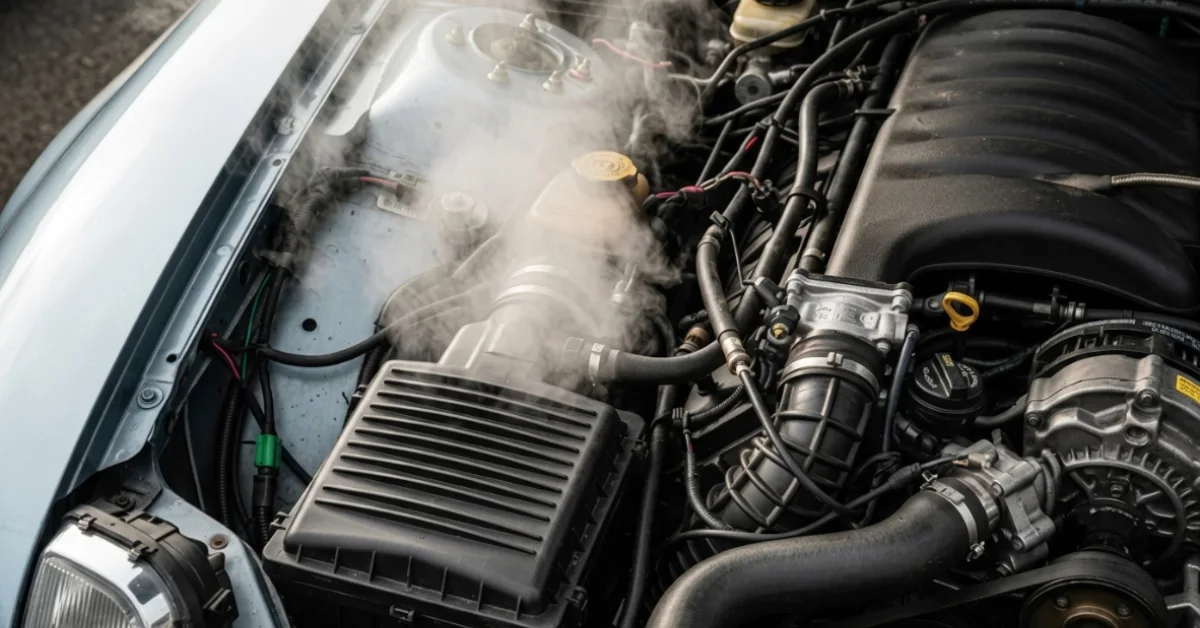
A coolant leak on a turbocharged engine is not something to monitor. See common causes of coolant leaks.
4. Timing Chains and Belts
Both are used across European ranges and both need attention, for different reasons.
Belts
A timing belt is a hard interval measured in years as well as distance. A belt that fails takes the engine with it.
Some European engines run the belt inside the engine, immersed in oil. On those the oil condition and the belt condition are the same subject, and debris from a degrading belt can block the oil pickup.
Chains
Chains stretch and their tensioners and guides wear. The warning is a rattle for a second or two on cold start.
That rattle is worth acting on rather than monitoring, because the components around it wear while it continues.
5. Crankcase Ventilation and Oil Consumption
The crankcase ventilation system vents pressure from inside the engine back into the intake.
When it blocks or its diaphragm fails, pressure builds and finds its way out through the seals. Owners then pay for oil leaks that were never seal failures.
It also contributes directly to intake valve carbon, so one neglected part causes two problems.
6. Long-Life Servicing in the Wrong Climate
Several European manufacturers offer an extended servicing regime that stretches the oil interval considerably.
It was calculated around steady motorway driving in mild European temperatures. Abu Dhabi provides stop-start traffic, short trips and sustained heat instead.
All three degrade oil faster than that calculation allows. Switching the car to the fixed, shorter interval is one of the most useful things an owner here can do.
What This Means for Ownership
None of the above makes European cars a poor choice. It makes them cars with a known maintenance profile.
- Service on the fixed interval, with the correct approval, and treat the oil as the turbo coolant it also is.
- Treat a cooling leak as urgent rather than something to top up.
- Plan carbon cleaning on a direct injection engine rather than waiting for a misfire.
- Treat the timing belt interval as a date on the calendar.
- Have the crankcase ventilation checked at service rather than after an oil leak.
Exotic Auto Services works on these engines daily and checks for exactly this list. See car engine repair.
Frequently Asked Questions
Are European cars less reliable in the UAE?
They are not inherently less reliable, but they are less tolerant of stretched maintenance in this climate. Small turbocharged engines with plastic cooling components and long-life service intervals were engineered around European conditions. Serviced on the fixed interval with the correct oil, they hold up well; neglected, they fail in predictable ways.
What is carbon build-up and does my car have it?
On direct injection engines fuel is sprayed into the cylinder rather than past the intake valves, so nothing washes those valves clean and oil vapour bakes onto them over time. It shows as lost throttle response, higher consumption and rough cold starts. Almost every modern European petrol engine is affected to some degree.
Why do European engines use plastic cooling parts?
Weight and cost, and in a temperate climate they last well. Here, heat cycling makes plastic brittle and those housings crack, which is why they behave as wear items in Abu Dhabi rather than lifetime components. It is a time and heat failure rather than a mileage one, so low-mileage cars are affected too.
Should I use long-life servicing on a European car here?
No. That regime assumes steady motorway driving in mild temperatures, and Abu Dhabi provides stop-start traffic, short trips and sustained heat instead. On a turbocharged engine the oil is also cooling the turbocharger, so the shorter fixed interval is protecting the expensive component.
Is a rattle on cold start serious?
It is worth acting on rather than monitoring. On many European engines a brief rattle at start-up points at timing chain tensioner or guide wear, and the components around it continue to wear while the noise continues. On some marques it can also be an exhaust manifold, which is a much smaller job, so it is worth identifying which.