Diagnostics
Understanding Car Diagnostics: What a Scan Can and Cannot Tell You
A fault code does not tell you which part has failed. It tells you which circuit reported a reading outside its expected range, and those are very different things. Understanding that difference is what stops you paying for parts you did not need.
What this guide covers
What the Car Is Actually Recording
Modern cars run dozens of control units, each monitoring its own sensors and actuators continuously.
When a reading falls outside the expected range for long enough, the unit stores a fault code and, on most systems, a snapshot of the conditions at the time.
That is the whole mechanism. It is a report of an out-of-range reading, not a diagnosis.
Why the Code Is the Start, Not the Answer
This is where most money gets wasted, and it is worth an example.
A code reading "oxygen sensor, bank 1" is frequently produced by a sensor working perfectly. It is reporting a mixture that is genuinely wrong, caused by an air leak, a fuel delivery fault or a misfire further upstream.
Replace the sensor and the code returns, because the sensor was the messenger.
The same is true of many codes: they name where the problem was detected, not where it came from.
If a workshop reads a code and quotes a part in the same sentence, that is a parts sale rather than a diagnosis. The honest version is that the code narrows the search, and the next step is testing what could have caused it.
The Three Things a Scan Gives You
Fault codes
The list of what has been reported, and whether each is currently present or historic.
A historic code that has not returned is useful history. A permanent one is an active fault.
Freeze frame
The snapshot of conditions when the fault stored: engine speed, load, coolant temperature, road speed, fuel trim.
This is often more useful than the code. A fault that only occurs at low speed on a cold engine is a very different search from one that occurs under full load.
Live data
The real work. Watching sensors report in real time, comparing what each says against what the others say, and against what the engine should be doing.
Live data is how you catch a sensor that reads plausibly but wrongly, which is the fault type that never sets a code at all.
The Faults That Set No Code
A common misunderstanding is that a clean scan means a healthy car. It does not.
- A mechanical noise. No sensor watches for a knocking wheel bearing.
- A sensor reading wrongly but plausibly. If it stays in range, nothing complains.
- Slow degradation. A tired water pump or a partly blocked radiator is a performance loss, not an error.
- Anything purely mechanical. Worn bushes, a leaking damper, a seized caliper slider.
This is why a scan is one tool rather than the whole inspection, and why a road test and a look on the ramp still matter.
Scan, Diagnosis and Why They Cost Differently
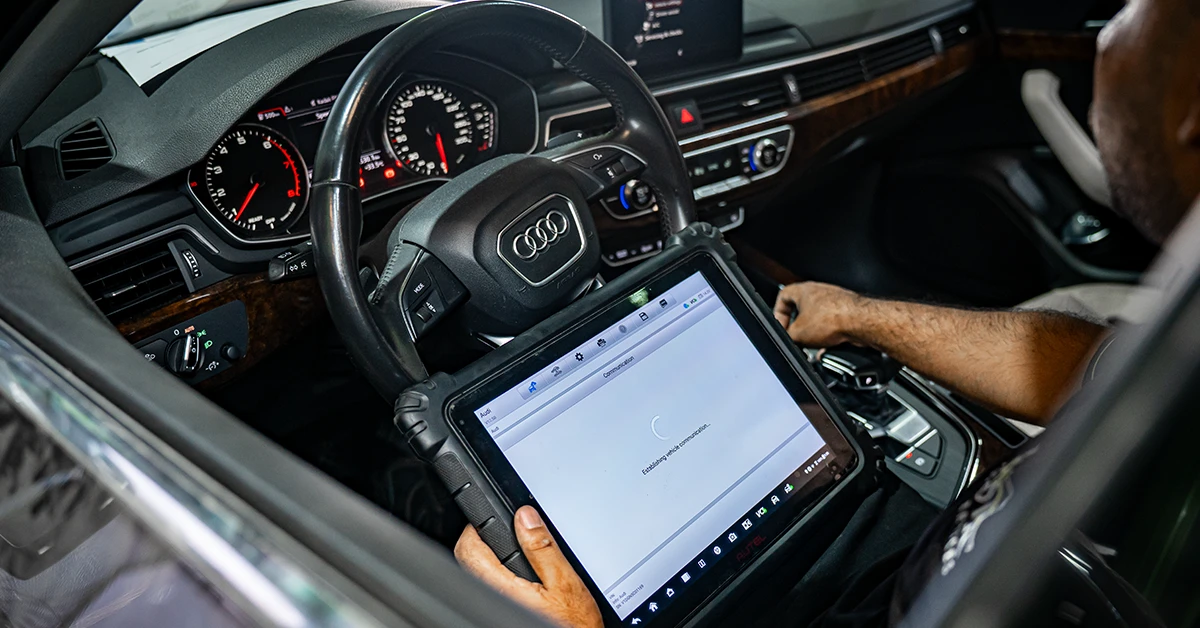
A scan is plugging in and reading what is stored. It takes minutes and it is inexpensive.
A diagnosis is establishing which of the possible causes is yours: live data, component testing, sometimes wiring checks. It takes time, and that time is the value.
Paying for a proper diagnosis once is almost always cheaper than paying for two or three parts fitted on the strength of a code.
What to Ask For
- Ask for the codes themselves, not a summary. They are yours and they are useful.
- Ask what the freeze frame showed. It tells you when the fault happens.
- Ask what was tested, not only what was concluded.
- Ask whether the fault is present or historic. These are different situations.
- Do not accept clearing codes as a repair. If nothing changed, the fault returns.
Exotic Auto Services shares the codes and the readings rather than only the verdict, because an owner who can see the evidence can make a decision.
For why manufacturer-level equipment matters on premium cars specifically, see why engine diagnostics are critical on modern luxury cars.
Frequently Asked Questions
Does a fault code tell you exactly what part has failed?
No, and this is the most costly misunderstanding in car repair. A code names the circuit where a reading fell outside its expected range. An oxygen sensor code, for instance, is frequently set by a sensor working correctly and reporting a genuine mixture problem caused by something else upstream.
Why does a diagnosis cost more than a scan?
Because they are different jobs. A scan is plugging in and reading stored codes, which takes minutes. A diagnosis is establishing which of the possible causes is actually yours, using live data and component testing, and that takes time. Paying for one proper diagnosis is usually cheaper than fitting two parts on the strength of a code.
My car scanned clean but something is clearly wrong. How?
Plenty of faults set no code at all. Mechanical noises, worn suspension, a seized brake slider and slow degradation such as a tired water pump are all invisible to the diagnostic system. So is a sensor reading wrongly but plausibly, because nothing complains while it stays in range.
Is it bad to clear fault codes?
It is not harmful, but it is not a repair either. Clearing a code removes the evidence, including the freeze frame data that says when the fault occurred. If nothing was actually fixed the code returns, and whoever looks at it next has less to work with than they would have had.
What is freeze frame data?
It is the snapshot of conditions recorded when a fault stored: engine speed, load, coolant temperature, road speed and fuel trim among others. It is frequently more useful than the code itself, because a fault that only appears on a cold engine at low speed is a completely different search from one that appears under full load.