Choosing a workshop
What Experience Actually Buys You
Experience gets described as a vague virtue, which is not much use when you are choosing where to take a car. In practice it comes down to two concrete things: the order faults get investigated in, and knowing what is normal for a particular car.
What this guide covers
The Order of Investigation
Given a misfire, there are a dozen possible causes. What separates a good diagnosis from an expensive one is the sequence they are examined in.
The correct order is cheapest and most likely first, then upward.
- Read the codes and the freeze frame, so you know which cylinder and under what conditions.
- Read live data while the engine runs.
- Swap components between cylinders. If the misfire follows the coil, that is the answer with nothing purchased.
- Test fuel delivery only once ignition is ruled out.
- Compression or leak-down test only if everything above comes back clean.
Anyone can arrive at the answer eventually. The difference is whether you paid for two wrong parts on the way. See how misfires are diagnosed.
Knowing What Is Normal
This is the one that saves customers the most money and it is almost invisible.
A great many cars come in with a complaint that is not a fault at all, and recognising that requires having seen the model before.
- A dual clutch hesitating in crawling traffic is characteristic, not a failing gearbox.
- A CVT holding engine speed while road speed builds is how it works, not slipping.
- Clear water under the passenger side after using the air conditioning is condensate.
- A brief brake squeal on a damp first stop is surface rust burning off.
- Light misting inside a headlight that clears while driving is the unit venting.
- A service reminder arriving early is the car calculating from how it is driven.
A workshop that does not know these will investigate them, and investigation costs money. Worse, some will find something to replace.
Pattern Recognition
The third thing experience provides is knowing that a particular symptom on a particular marque is a known item.
A rattle on cold start might be a timing chain tensioner, or on some engines an exhaust manifold, and those are very different repairs. Knowing which is common on that engine narrows it immediately.
A gradual loss of shift quality on certain gearboxes points at a specific adapter sleeve rather than a general search.
Coolant loss with no visible leak on a particular engine points at a known plastic housing.
None of this replaces testing. It changes what gets tested first, which is where the time and money go.
This is also why marque familiarity matters more than years in the trade generally. Someone who sees a particular engine weekly knows its patterns; someone excellent but unfamiliar with it starts from first principles.
Being Willing to Say No
The least visible marker and possibly the most useful one.
It costs a workshop money to tell you that a scratch will polish out, that the noise you heard is characteristic, that your brake pads have another year in them, or that a gearbox is not worth repairing on the value of the car.
A workshop that does that is one worth returning to, and that behaviour is the thing to look for rather than a list of credentials.
What to Ask
Rather than assessing experience in the abstract, these questions test for it concretely.
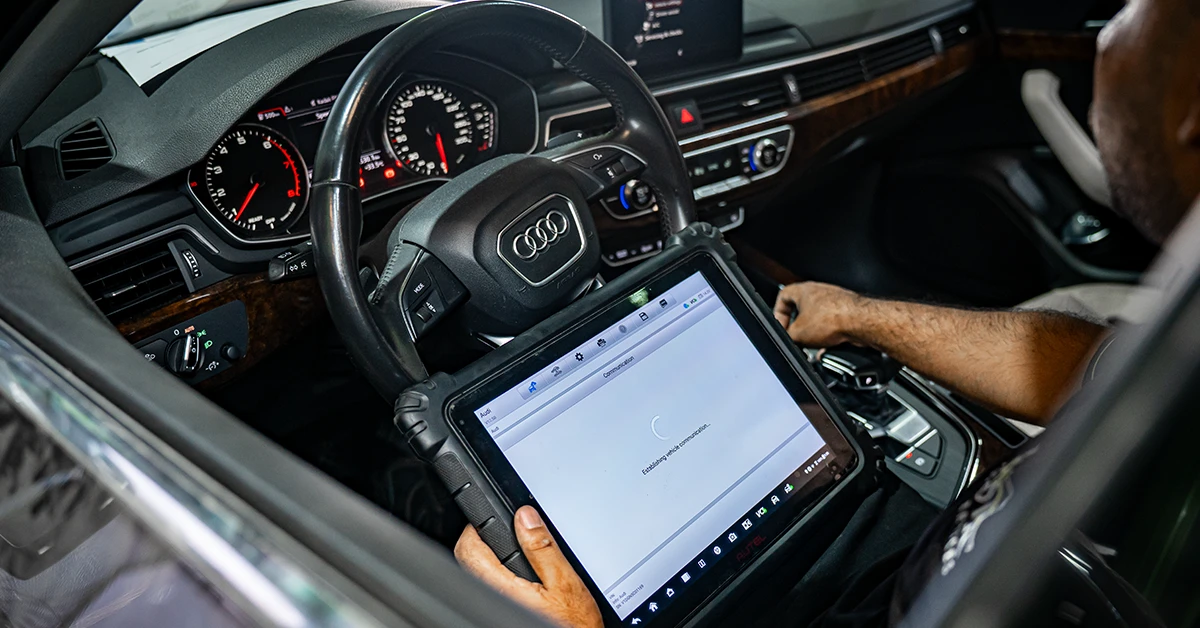
- Can you read all modules on my car, or only the engine?
- Can you register a battery and put the parking brake into service mode on this marque?
- Will you show me the codes and the measurements, not just the conclusion?
- What will you test before replacing anything?
- Will you call me before doing work beyond what we agreed?
The answers to those tell you more than any amount of general reassurance.
For the specific failures that follow when the answer to the first two is no, see seven repairs that go wrong without the right equipment.
What It Is Worth
The value is not in doing the same job better. It is in doing the right job the first time, and in not doing jobs that were never needed.
Both are invisible on an invoice, which is exactly why the cheapest quote is a poor way to choose for anything beyond the most routine work.
Exotic Auto Services in Musaffah shares codes and measurements rather than conclusions, so you can see what a decision was based on.
Frequently Asked Questions
What does an experienced mechanic actually do differently?
Two things concretely. They investigate faults in the right order, cheapest and most likely first, so you do not pay for parts on the way to the answer. And they know what is characteristic rather than faulty on a particular car, which prevents investigating something that was never wrong.
Does it matter if a workshop knows my specific brand?
More than general years in the trade, in many cases. A rattle on cold start might be a timing chain tensioner or an exhaust manifold depending on the engine, and those are very different repairs. Someone who sees that engine regularly knows which is common on it and narrows the search immediately.
How can I tell if a workshop is any good before committing?
Ask concrete questions rather than general ones: can you read all modules or only the engine, can you register a battery and use brake service mode on this marque, will you show me the codes and measurements rather than just the conclusion, and will you call before doing work beyond what we agreed.
Is the cheapest quote ever the right choice?
For routine work with a clearly defined scope, often yes. For diagnosis or anything involving electronics, it is a poor filter, because the value is in doing the right job first time and not doing jobs that were never needed. Neither of those appears on an invoice.
Should a workshop ever tell me I do not need work?
Yes, and it is one of the best signals there is, because it costs them money. A scratch that will polish out, a noise that is characteristic, brake pads with another year in them, or a gearbox not worth repairing on the value of the car are all answers worth more than a quote.