02 555 5563
  Working hours: 9am - 7pm

Car Suspension Bushes – The Ultimate Guide Diagnosis, Longevity and Replacement Cost
Introduction
The undercarriage of a vehicle is subject to a severe environment. Fine desert dust, aggressive road filth, and intense temperature stress are constantly degrading rubber components that result in structural problems underneath the chassis in short order. Car suspension bushes usually last from 60,000 to 100,000 kilometers, although it may vary significantly based on driving behaviors and the climate. When these elastomeric components fail, they impact vehicle safety, handling accuracy and ride quality, turning a smooth ride into a jarring, vibrating misery.
What are Car Bushes? The Mechanics of Undercarriage
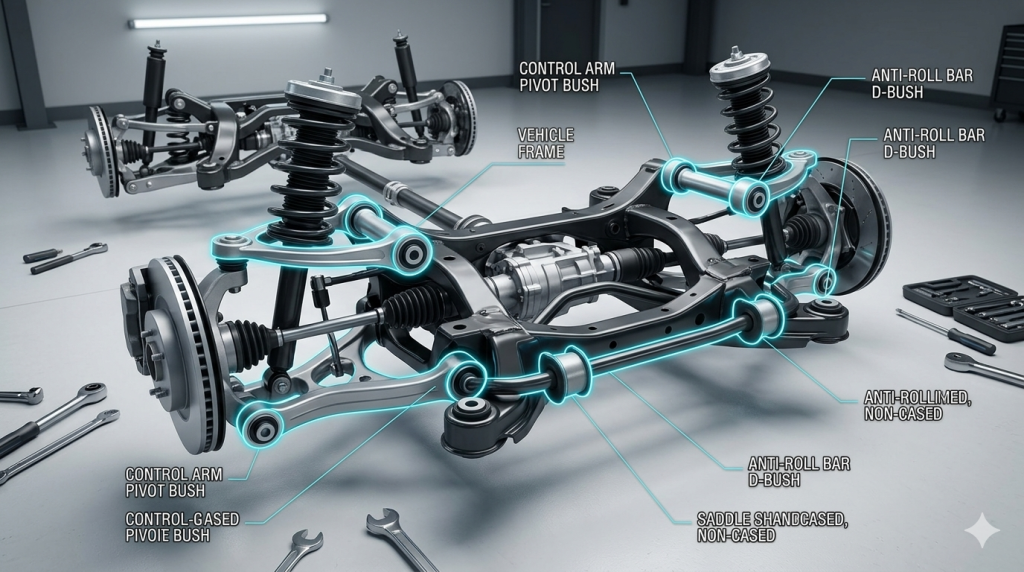
Car suspension bushes are flexible elastomeric cartridges, which provide vital isolation barriers between the moving metal suspension components and the unyielding steel chassis of a car. These little sleeves press right into your control arms, trailing links and sway bars. They slide easily to reduce metal-on-metal friction and yet enable the movement in several axes that is required during cornering and during suspension travel. Knowing what car bushes do assist you understand why your car can go over bumps gently but yet have predictable steering control.
Isolation Engineering: Absorbing Road Energy and High Frequency Vibrations
The major technical purpose of a suspension bushing is noise, vibration and harshness (NVH) attenuation. When your tires go over bumps, high frequency kinetic energy travels up through the steering knuckles and control arms. Without an interface these vibrations would be transmitted straight into the cabin, would be too noisy and would create structural strain. The load causes the inner elastomeric matrix to give, turning the mechanical shock energy into harmless heat energy before it may affect passenger comfort.
Wheel Alignment Safety: How to Maintain Camber and Toe Angles Under Load
Suspension bushings are important not just for comfort but also for the correct alignment of your wheels under dynamic loading situations. When you brake hard or turn at speed the suspension links are subjected to a lot of lateral and longitudinal forces. The durometer or hardness of the bushing material prevents the pivot bolts from moving out of place. Controlling this chassis movement, the bushings guarantee your tires keep their optimum contact patch with the road surface, maintaining precise camber and toe settings at the times you need traction the most.
Anatomy of Wear: How to Tell If Your Arm Bushes are Failing Car Systems
Checking the handling stability of your vehicle requires constant observation of the lower and upper control arm assemblies. If left unchecked, automotive components such as arm bushes may soon start a domino effect of mechanical handling problems.
Control Arm Deflection: Diagnosing Steering Play & Uneven Tire Wear Patterns
In case of inner sleeve separation in an arm bushes vehicle system, the control arm has more freedom of movement under the load. This uncalibrated play results in too much dynamic alignment drift. You will feel this as a hazy, wandering steering wheel feel or a pronounced tug to one side while braking hard. This unintentional movement also exposes the tire treads to uneven scuffing forces that cause quick inner-edge cupping or feathery tire wear patterns that may damage premium rubber in a matter of months.
Structural Dry Rot and Tearing and How Extreme Heat Accelerates It
Standard OEM natural rubber formulations are particularly vulnerable to environmental deterioration. In dry locations, with severe seasonal heat waves, undercarriage temperatures go up. This tremendous heat load bakes the volatile plasticizers right out of the rubber compounds, and causes structural cracking and deep surface dry rot.
A simple visual check may easily overlook an early stage inner sleeve split. The mechanic needs to drive the car up on a hoist with the suspension loaded, then apply leverage with a chassis pry bar straight to the joint to locate concealed elastomer failure. This simulates real world stresses on the road and reveals extensive interior shredding or delamination of the rubber from the central metal sleeve that would not be seen with the wheels hanging free on a typical frame lift.
Dampening Stabilization: How Car Shock Absorber Bushings Work?
Control arm bushings provide lateral control, while the components that isolate your dampening struts handle vertical impact loads. Ignoring your automobile shock absorber bushes might lead to costly structural damage to your upper chassis panels.
Mount Disintegration, Upper: Diagnosis of Metallic Clunking Sounds Over Speed Bumps
The top mount shock bushing is a part of the highest point of connection of your suspension strut. Every time the vehicle goes over an obstacle these automobile shock absorber bushes are in a continual compression cycle. Over time the inner rubber core wears down, generating a tiny physical space between the strut shaft piston and the car body. Driving over speed bumps or potholes, this gap enables the metal shaft to bash straight into its mounting pocket, creating a harsh metallic clunking sound which means you’ve lost all dampening isolation.
Hydraulic Fluid Leaks: Oil Leaking Next Door Destroys Rubber Isolation Mounts
Failure of the internal hydraulic seals in the damper often accelerates the wear of shock absorber bushings. When an active strut starts losing its internal damping fluid, the seeping petroleum based oil pours right down saturating the lower automobile shock absorber bushes. Standard natural rubber compounds are not oil resistant, and this continual chemical attack cuts the polymer chains. The rubber immediately softens and becomes spongy and loses its structural structure . This ruins the car dampening alignment .
Financial Projections: Understanding Car Bush Replacement Cost Metrics
Understanding the things that make up your vehicle bushes replacement cost invoice can assist you to have reasonable expectations when arranging repairs, before you sign off on any expert mechanical work.
Hydraulic Press Extractions: Parts vs. Labor Realities and Service Times
This is one of the most prevalent questions luxury automobile owners have when it comes to the final car bushes replacement cost, which is so strongly weighted toward labor rather than the price of the new parts. The bushings themselves are relatively cheap replacement parts. But to remove a worn bushing, you have to remove all of the multi-link aluminum suspension components from the car.
The technician then mounts the control arm to a specific hydraulic press once it has been removed. The technician must use exact pressure to push out the seized metal outer casing without twisting or bending the structural aluminum arm, using custom-machined adaptor sleeves. It is a delicate procedure , it takes time , it needs specific equipment and a lot of technical knowledge .
Complete Control Arm Replacement vs. Bushing Press-Fit
When a suspension system is worn, car owners have generally two different repair techniques to consider:
- Isolated Bushing Press-Fitting: This is to change just the defective elastomer cartridge in a workshop hydraulic press. This is a cost saving measure on components prices, therefore making a very tempting choice for high end luxury automobiles when a naked control arm casting is quite costly.
- Full Control Arm Replacement: For many current sports cars and large volume commuter vehicles, the factory bushings are pre-installed into a full control arm assembly. If the arm has an integrated ball joint that is coming loose, then in the long run it is typically cheaper to replace the complete structural arm since it removes the need for labor expenses in the future.
Exotic Auto Services Precision Suspension Engineering
To restore the crisp, factory-fresh handling of a premium car takes highly specialist technology that is far beyond the capability of a local repair shop. The skilled mechanical staff at exoticautoservices.ae restores suspension with factory level accuracy.
The workshop uses modern wireless chassis ears to calculate latent bushing deflection while the car is moving. When a bad mount is located, technicians execute high-pressure press-fit extractions in calibrated hydraulic jigs. This cautious method minimizes structural micro-fractures in light-alloy control arms and guarantees the replacement bushings sit absolutely level inside their mounting bores.
The factory also provides high durability polymer and heavy duty polyurethane durometer modifications to handle the tough local driving conditions. These quality materials meet worldwide automobile engineering requirements such as the SAE worldwide technical standards, making sure that your new suspension system offers long-lasting durability and accurate handling safety.
Conclusion
Your vehicle’s suspension bushings may be little, out-of-sight components, but they are critical in controlling daily handling, safety and cabin comfort. So, by being proactive and correcting early warning indications of bushing failure such as a drifting steering wheel, uneven tire wear, or metallic clunking sounds, your automobile will not suffer costly, deep-seated steering problems down the road. Opt for high-durability polyurethane or OEM-grade polymer options to protect your vehicle’s undercarriage from the wear and tear of harsh climatic conditions. When you trust the experts at Exotic Auto Services to realign your car’s multi-link suspension, you are ensuring that your vehicle is returned to the road with factory-spec accuracy, offering a refined, smooth ride every time you hit the road.
Frequently Asked Questions Q&A
Q: How do automobile bushes work for vehicle handling safety?
A: Suspension bushings allow your wheels to be correctly aligned and be able to withstand high lateral and longitudinal forces during cornering and braking. This keeps your tyres securely planted on the road, delivering predictable, safe handling control.
Q: How can I check for worn out arm bushes auto parts without removing the wheel?
A: Look for uneven, quick tire tread degradation on the inside edges, a steering wheel that pulls or feels loose, or noticeable clicking and popping noises when you crank the steering wheel at low speeds.
Q: What do you think causes the cost of replacing automobile bushes to differ between premium and economical models?
A: Luxury and exotic cars have complicated multi-link aluminum suspension systems that take a lot of effort to take apart. They also need specific press adapters and high-end OEM parts, which adds to the total labor time compared to conventional steel suspension setups.
Q: Why are the shock absorber bushes of the automobile checked at the time of replacement of tires?
A: Worn shock absorber bushes might enable the tyre to bounce out of control under load. This fast movement generates cupped tire wear patterns, which means that old worn-out bushings may rapidly damage a fresh new set of tires.
Q: Can worn automobile suspension bushes cause lasting harm to my steering rack?
A: Yes. Failed bushings may allow excessive movement and vibration to be transmitted right up the steering tie rods. This constant sharp input might wear out the internal seals and gear teeth of your central steering rack over time.
Related Posts